

neoMS: presentation, not only binding
neoMS is myNEO's HLA-agnostic MHC presentation prediction algorithm. It ranks peptides by whether they are likely to be processed and displayed on the cell surface, not by binding affinity alone.
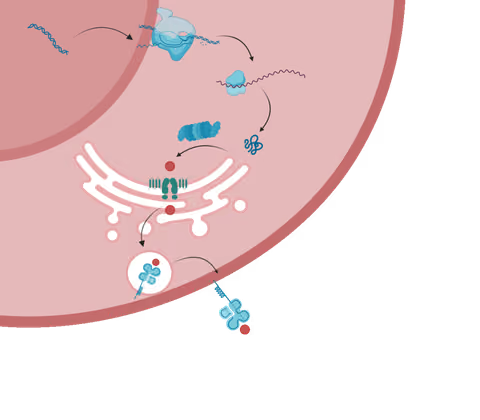
Trained on what is presented, not what merely binds
Antigen processing includes cleavage, transport, MHC binding, and surface presentation. Binding predictors capture only one of those steps, which is why high-affinity peptides often fail ligandome screens.
neoMS is trained on mass-spectrometry MHC ligandomic data, so ranking reflects peptides that actually reach the cell surface. Architecture, training data, and performance are in the paper.
HLA-agnostic, MHC class I and II
HLA-agnosticAlleles not seen in training
Because neoMS maps peptide sequence to HLA sequence, it can score alleles that were not observed during training, rather than being limited to a fixed allele panel.
Class I and IICD8 and CD4 contexts
neoMS was originally developed for MHC class I. It now also covers MHC class II, so presentation ranking can support both CD8+ and CD4+ target selection.
StandaloneUsed inside and outside ImmunoEngine
neoMS ranks candidates in the ImmunoEngine pipeline and in dedicated workflows such as mySHARED and myPATHOGEN.
The evidence behind neoMS
The neoMS architecture, training data, and presentation-prediction performance are described in Mill et al., bioRxiv 2022.
What is neoMS?
neoMS is myNEO's deep-learning MHC presentation prediction algorithm. Rather than modeling binding affinity alone, it models the full antigen-processing and presentation pathway, including proteasomal cleavage, TAP transport, MHC binding, and presentation. It is HLA-agnostic, enabling predictions for alleles not observed during training. Originally developed for MHC class I, neoMS now also covers class II.
How is neoMS different from MHC-binding predictors?
Most presentation tools score MHC binding affinity. Binding is only one step of antigen processing, and it is a poor proxy for whether a peptide actually reaches the cell surface. neoMS is trained on mass-spectrometry MHC ligandomic data and uses a transformer-based, sequence-to-sequence model so ranking reflects presentation, not binding alone.
Where is neoMS used?
neoMS is used inside ImmunoEngine to rank candidate antigens, and as a standalone algorithm in dedicated discovery workflows such as mySHARED and myPATHOGEN.