

ImmunoEngine: neoantigen discovery beyond small mutations
ImmunoEngine is myNEO's computational antigen discovery pipeline. It identifies tumor-specific antigens from whole-genome sequencing, then ranks them by the quality of the genomic event, MHC presentation, and T-cell immunogenicity.
A wider antigen landscape than SNVs and indels
Most neoantigen pipelines stop at small coding mutations. ImmunoEngine uses whole-genome sequencing, so it also captures transposable elements, intronic events, gene fusions, neoisoforms, and camyotope dark-genome targets. That added antigen space is especially relevant for patients with low tumor mutational burden, where SNV and indel discovery often yields too few candidates.
That wider search uses DNA and RNA sequencing data from the tumor, and DNA sequencing from matched healthy tissue. Comparing tumor and healthy DNA identifies alterations that are tumor-specific rather than inherited. Tumor RNA then shows which alterations are expressed. ImmunoEngine also characterizes HLA type and the tumor microenvironment before ranking begins.
Score the event, then the peptide
ImmunoEngine scores both the genomic event and the peptide it produces. The event is assessed for prevalence, clonality, tumor specificity, and expression. The peptide is assessed for presentation likelihood and predicted immunogenicity.
Event scoreQuality of the alteration
Each genomic event is scored for prevalence, clonality, tumor specificity, and expression, so ranking stays tied to variants that are present in the tumor and actually made into protein.
Peptide scorePresentation and immunogenicity
neoMS models the full MHC presentation pathway. neoIM predicts CD8+ and CD4+ T-cell immunogenicity. Together they rank peptides that can reach the cell surface and elicit a T-cell response.
Combined rankingSelect the final set
Event and peptide scores are combined to select the final epitope set, accounting for immune-escape risk. The outputs are in-silico predictions that prioritize laboratory work; they do not replace experimental validation.
From sequencing to ranked targets
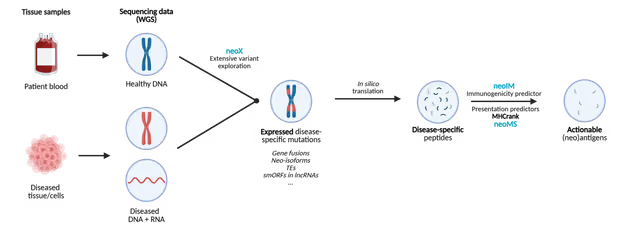
ImmunoEngine is the discovery pipeline behind the personalized myNEO workflow. neoMS and neoIM are also used on their own in other solutions.
Published methods behind ImmunoEngine
The ranking algorithms inside ImmunoEngine are described in peer-reviewed papers. A methods paper covers the broader neoantigen-prediction workflow.
What is ImmunoEngine?
ImmunoEngine is myNEO's computational antigen discovery pipeline. It calls variants from whole-genome tumor and healthy sequencing data, including events beyond SNVs and indels such as fusions, neoisoforms, and dark-genome camyotopes. It characterizes the patient's HLA type and tumor microenvironment, predicts MHC presentation with neoMS, scores immunogenicity with neoIM, and ranks the resulting targets.
What is neoantigen discovery?
Neoantigen discovery identifies tumor-specific antigens the immune system can recognize. ImmunoEngine performs neoantigen discovery from whole-genome tumor and healthy sequencing, then uses neoMS presentation prediction and neoIM immunogenicity prediction to rank candidates for vaccine, T-cell, and other immunotherapy programs.
Why does ImmunoEngine use both DNA and RNA sequencing?
myNEO uses DNA and RNA sequencing data from the tumor and DNA sequencing from matched healthy tissue. Comparing tumor and healthy DNA identifies alterations that are tumor-specific rather than inherited. Tumor RNA then shows which alterations are expressed, helping prioritize actionable targets for therapeutic development.
How does ImmunoEngine prioritize neoantigens?
ImmunoEngine scores both the genomic event and the peptide it produces. The event is assessed for prevalence, clonality, tumor specificity, and expression. The peptide is assessed for presentation likelihood and predicted immunogenicity. These factors are combined into a ranking used to select the final epitope set while accounting for immune-escape risk.
Why does myNEO use whole-genome sequencing instead of exome sequencing?
Whole-genome sequencing reveals tumor alterations that exome panels cannot detect, including gene fusions, transposable elements, neoisoforms, and translated non-coding regions. In tumors with low mutational burden, these dark-genome events can provide actionable targets when exome-based discovery finds few candidates. Whole-genome sequencing also supports higher-confidence variant calling.
What are the limitations of myNEO's computational predictions?
myNEO's outputs are in-silico predictions that prioritize and de-risk candidates before laboratory work. They reduce the number of candidates and experiments required, but they do not replace experimental validation and do not guarantee presentation, immunogenicity, safety, or clinical efficacy.